Hope
is the crowd so thin
you can hear
squeaky tank tracks
😂
A scared but curious artist and poet in Milton Keynes
Hope
is the crowd so thin
you can hear
squeaky tank tracks
😂
‘In Notes from Underground, Fyodor Dostoyevsky insisted that “too great a lucidity is a disease, a true, full-fledged disease,” that the artist’s heightened consciousness forced him to recognize unbearable truths, hidden from ordinary mortals.’
‘Friedrich Nietzsche – who confessed that Dostoyevsky was “the only psychologist, incidentally, from whom I had something to learn” – also associated the creative spirit with extreme pain and mental anguish, but took this idea one stage further. He argued that artistic greatness could be earned only by suffering, and that the artist must induce the creative spirit: “To make oneself sick, made, to provoke the symptoms of derangement and ruin – that was becoming stronger, more superhuman, more terrible, wiser.” The artist’s derangement gave him the power to see and tell the truth, and his suffering was paid with insight.’
‘Jean-Paul Sartre voiced the quintessential modern idea that the writer’s talent was closely connected to his capacity for self-ruin: “In relation to Gauguin, van Gogh and Rimbaud, I have a distinct inferiority complex because they managed to destroy themselves … I am more and more convinced that, in order to achieve authenticity, something has to snap.”‘
‘[Lowell] loved the idea of falling in love, and in his recurring manic episodes he needed women at the center of his emotional and artistic life. Each affair became an intense dramatic episode. […] he idealized his loves …’
My poem ‘Cuckoo’s Heart’ was highly commended in the MK Lit Fest 2025 writing competition.
I think of all the things I do and am, poetry is the thing I need validation for least, simply because it gives me a high like nothing else.
But it does feel bloody nice!
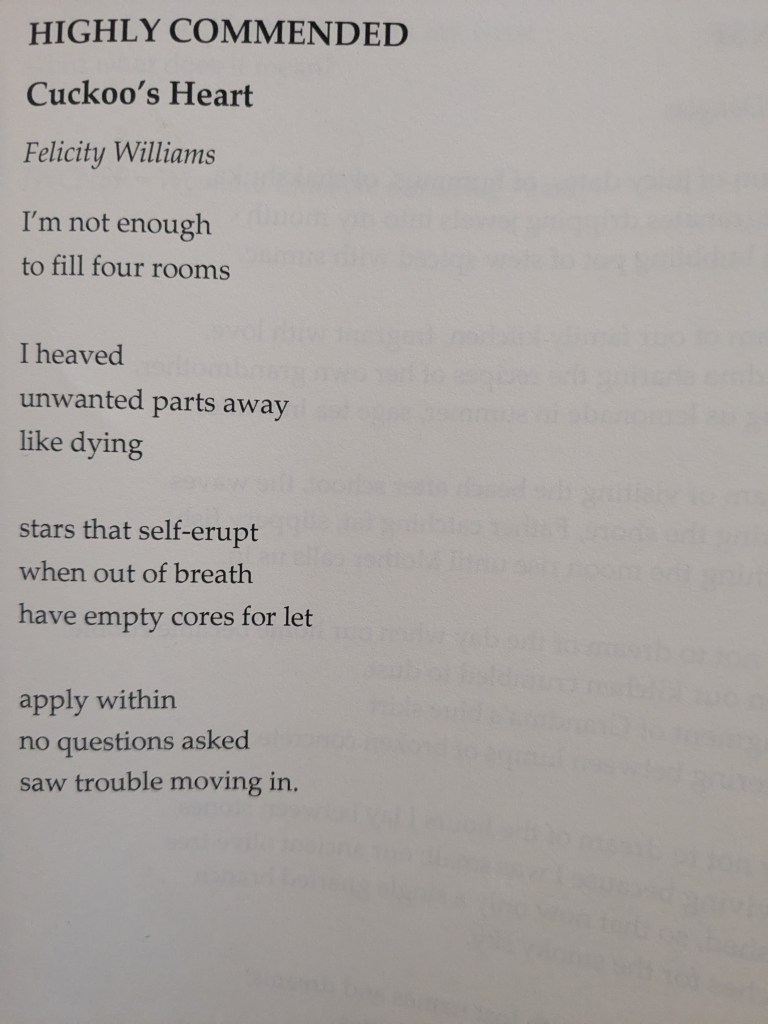
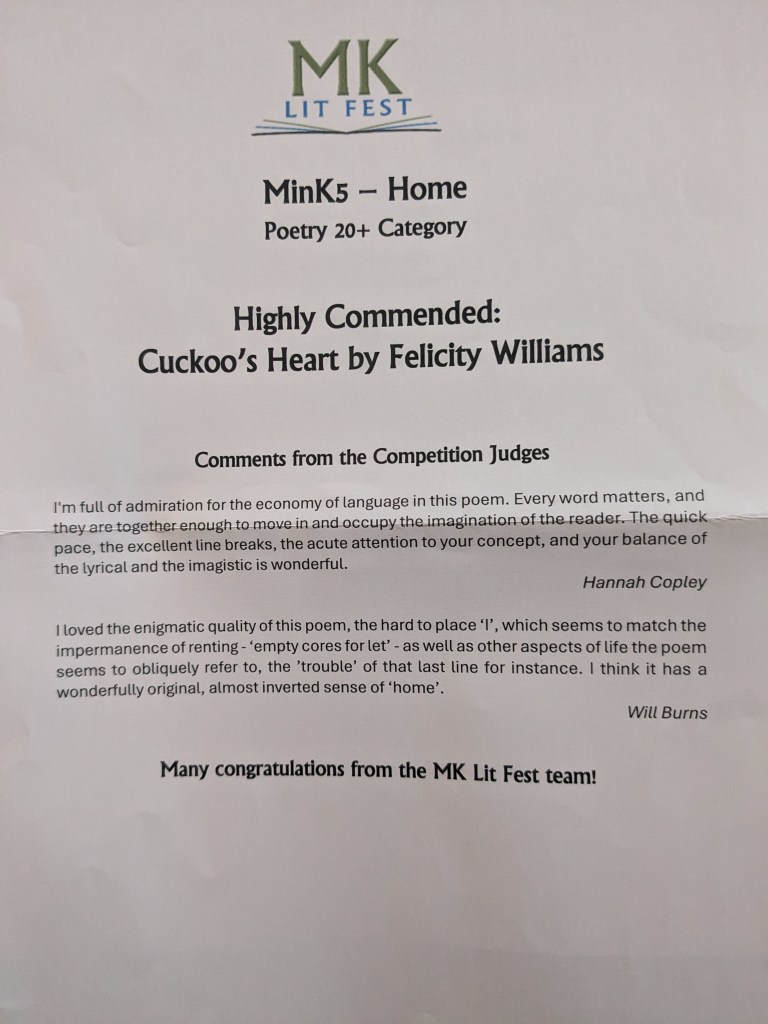
Week 2 of the book ’52 – a year of poetry writing prompts’ from Nine Arches Press.
Commute
Lasso the time like gravity
snap future into memory
a blur like current through a wire
lasso the time like gravity
I’m braced; a body drawn through space
a hare in tortoise carapace
lasso the time like gravity
snap future into memory.
Love passed, the muse appeared, the weather
of mind got clarity newfound;
now free, I once more weave together
emotion, thought and magic sound.
—Aleksandr Pushkin
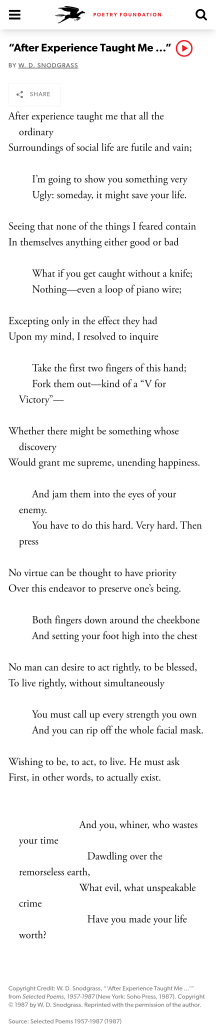
am I only just discovering, for the very first time, this extraordinary poem by W. D. Snodgrass?
Such joy upon discovering things still worth discovering.
https://www.poetryfoundation.org/poems/42790/after-experience-taught-me-
I have bought the book, ’52 – Write a Poem a Week. Start Now. Keep Going’, a Nine Arches Press book.
This first poem has taken two weeks rather than one. I’ve decided to be ok with that. I am determined to work each prompt.
The resulting poem for prompt one is not exactly as positive as the prompt suggests. I really did try. I’m just going with it.
I’m getting too old for this
Enough
of living in this claw
machine of packaged dreams
in plastic bubbles, burst when touched
the inside out for all
to see, I want to hold a shape
a gentle mind to cup it
reflection warped, a second face
look left while I look right
forget the claw above me.
‘Turn a page, and you find a new distraction, or another version of reality. Is this not the search for a fuller kind of experience? Art, which helps us focis on our quality of life, might also inspire a richer understanding of our mortal existence.’
‘There’s nothing straightforward in the relationship a thoughtful person has with their Self, and especially with its human frame, in which body-image is just the most visible manifestation of that inner dialogue. Ageing only makes the dialogue more complex. How to shed early-life fantasies or mid-life anxieties, and acquire late-life wisdom?’
‘”I don’t think ageing is the loss of youth. Ageing is ageing. Every stage of the life cycle is potentially interesting if you don’t thikn of it elegiacally, if you don’t think, ‘What have I lost?’ but instead, ‘What can I do now?’ There will be more possibilities when we are 70.”‘
‘In [Adam Phillips’] long essay Darwin’s Worms, he expresses this resilience […]: “People’s capacity to survive loss and even deastation is at once a banal andremarkable fact. We can’t help but be amazed by what people live through.”‘
‘Works of literature fill the void of faithm but in the end, everything goes pear-shaped. The best-laid plans fail. Trust in good health ges betrayed. Futures go south. Rational projections spin awry; families implode. Chance, fate, old age, mortality, and finally oblivion take over. Bereavement cuts through the hopes of living like a schythe.’
I’ve been thinking about death. A lot. As in, all the time. As in, everything is blighted by my thoughts of it. I find myself apprehensive about seeing my parents because I will be looking for signs of frailty, ageing, ill health.
People endure this, have done for millennia. Yet I feel (normally perhaps) that I can’t, or that I am not doing it properly.
Since losing my grandparents last year I feel that the whole world is different and will never be the same – likely a common feeling after losing the matriarch and patriarch of any family. The grief I feel continues to form like skin over hot milk. I try to drink but to clings and scolds my lips. I scrape it away and it gradually reforms.
‘In Grief Works, Julia Samuel, a veteran grief counselling, explored the necessity of coming to terms with grief and the emotions associated with loss. Samuel writes, […] “Our culture is imbued with the belief that we can fix just about anything and make it better; or, if we can’t, that it’s possible to trash what you have and start all over again. Grief is the antithesis of this belief: it requires endurance, and forces us to accept that ther are some things in this world that simply cannot be fixed.”‘
I am on the verge of talking to my GP about it, for fear that it may continue to get worse. I know I woudl benefit from talking to a psychotherapist but due to a job change I will be a little short on money for a while. In the meantime there are books (thank goodness for writers!) I’ve been wondering whether reading a lot about death is helping or hindering. I’m not sure, only that writing it out here does feel good. I recognise that at least some of my resistance to entering the flow state is because time seems to disappear. The alternative is to sit and do nothing and feel depressed, but at least I have the illusion of controlling time, of grasping it. Ironic considering that ‘seize the day’ means doing something with it rather than nothing. The sitting is at once comforting and depressing.
What the hell is all this about!? Where’s the get out clause? Oh crap the get out clause is death. Well that’s no good!
I am coming to accept that death is my thing. Now I just need to accept that we are all ageing and will die. Sitting and waiting and despairing would not be considered a good death, not to mention a good life. Yet I seem to have lost my way, hopefully just temporarily. I am clinging to the remainder of my 30s like a life raft with a puncture, clinging to useful plastic rather than lying back and floating like the RNLI recommends. I’m living in a panic that might kill me prematurely.
‘I have lived with the mystery of the brain, and I think I am happy to fade into a mystery beyond the magic of the cortex. Intellectually, that seems like the best bet for the future.’
Not so much ‘we stand with Ukraine’ anymore if that performance by Lisa Nandy on GMB is anything to go by, speaking of the USA like the codependent partner we are, most do everything we can to maintain the special alliance.
What?
The US has crapped all over the so-called special alliance. I stand with Ukraine, Trump can go to hell. I hope the PM decides we’re not going to follow him there, but not feeling hopeful.
And can those in the media please stop saying it’s a difficult and delicate balance? It’s not difficult, it’s not complex. It’s very, very simple. Trump will threaten whether we act to please him or not. Let’s not sell our integrity for nothing.
‘”What you see is what you get” these women said about themselves. For me lying created just the right amount of problems and what you saw was just one of my four or five faces – each real, each with different needs.’
‘You had to withstand a profound sense of wrongness if you ever wanted to get somewhere new. ‘
‘I should have a lover, sure, but also other specialised relationships – someone who I only cried with, someone for mutual back-scratching, artistic pilgrimages; I could be the part-time child or pet of a lonely adult, how interesting for both of us – and each of these people could be anyone, from any walk of life. I had always done this kind of thing but in secrecy […], or in my work (harmless make-believe) or while belittling myself [what a kook!] when really this was no trifling matter. A person with a journeying, experimental soul should be living a life that allowed for it.’
‘I tried to imagine a woman just like me but without secrets. Unapologetic. Would such a woman be acceptable or we she be cast out like a witch?’
‘He didn’t understand that you could create a world – a fantasy, a nightmare – and bring other people into it, not just artistically but in life. I was pretty good at getting people to meet me in my mind, but ultimately no one wanted to stay there.’
Have a WordPress.com account? Log in now.

