Going to say it now while feeling uncharacteristically open and vulnerable :
A shout out to all those counselling clients putting in the work. Including myself in this – Woah, I know! Self praise! Fuck it, this is my space. It’s hard but so worth it. But my god, it’s hard. Actually it’s hard, and then some.
To all the clients – that shame you feel? Fuck it, you’re amazing to be doing what you’re doing. Keep being vulnerable and sad and curious and brilliant. Ignore the voice that says YOU SHOULDN’T BE SAYING THIS. Your thoughts are your own and it’s amazing you’re acknowledging them. Few people will know the challenge that it is for you to recognise what’s going on for you,to show up, to go on with your day through all the tiny stabs of shame for Every. Tiny. Thing. You are.
Even the histrionic part. Embrace it! It’s been fucking hard for you, locked up in shame. Let it out.
Note to self : you’ll be back to shame in the morning. Enjoy it while you can.
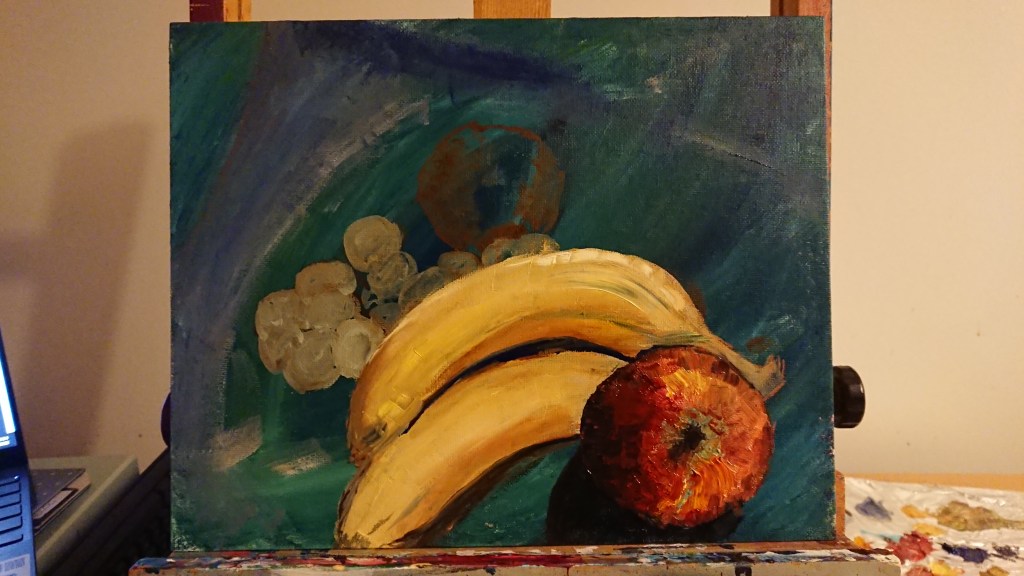
I’m lazy and impatient, so I want to work quickly. Oil paints are lovely but with all the faff of the solvents, plus my “studio” being the spare bedroom, I’ve always tried to make acrylic paints work for me.
But they dry so flipping quickly!
“You’re impatient!” I hear you cry. “You should love that!”
As well as being impatient I also do not do well under pressure, and the pressure of the quick acrylic drying time is TOO MUCH.
I’m the worst combination of things
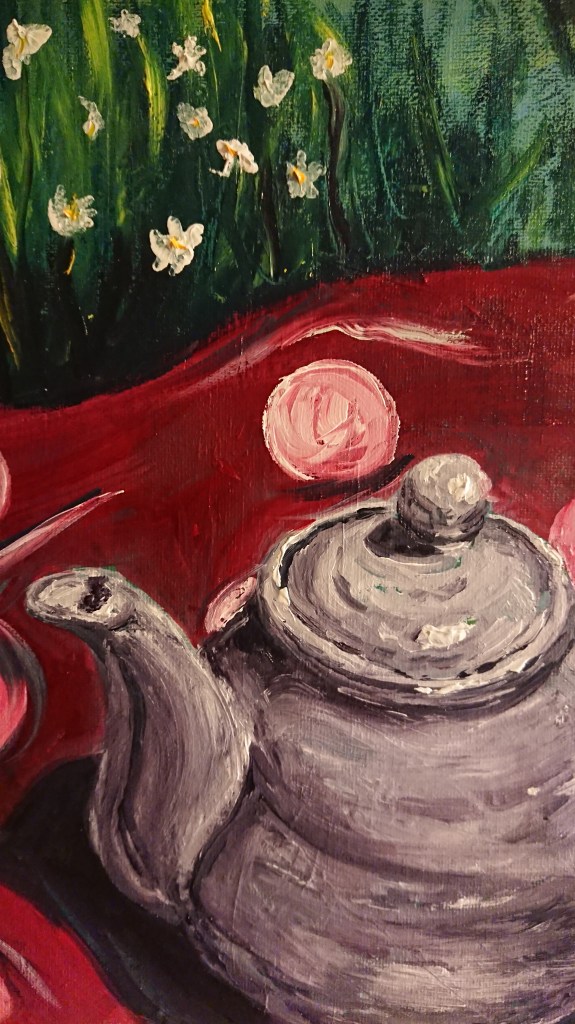
So, happy days, I’ve bought some water mixable oil paints and I love them! So thick and wonderful, so exciting to paint with. Don’t have to worry about intoxicating myself, and no pressure of quick drying times on the pallet.
On the canvas I get to do all the lovely blending, which my impatient side enjoys for a time, until it insists on moving on to the next painting before the previous is finished.
Love love love.
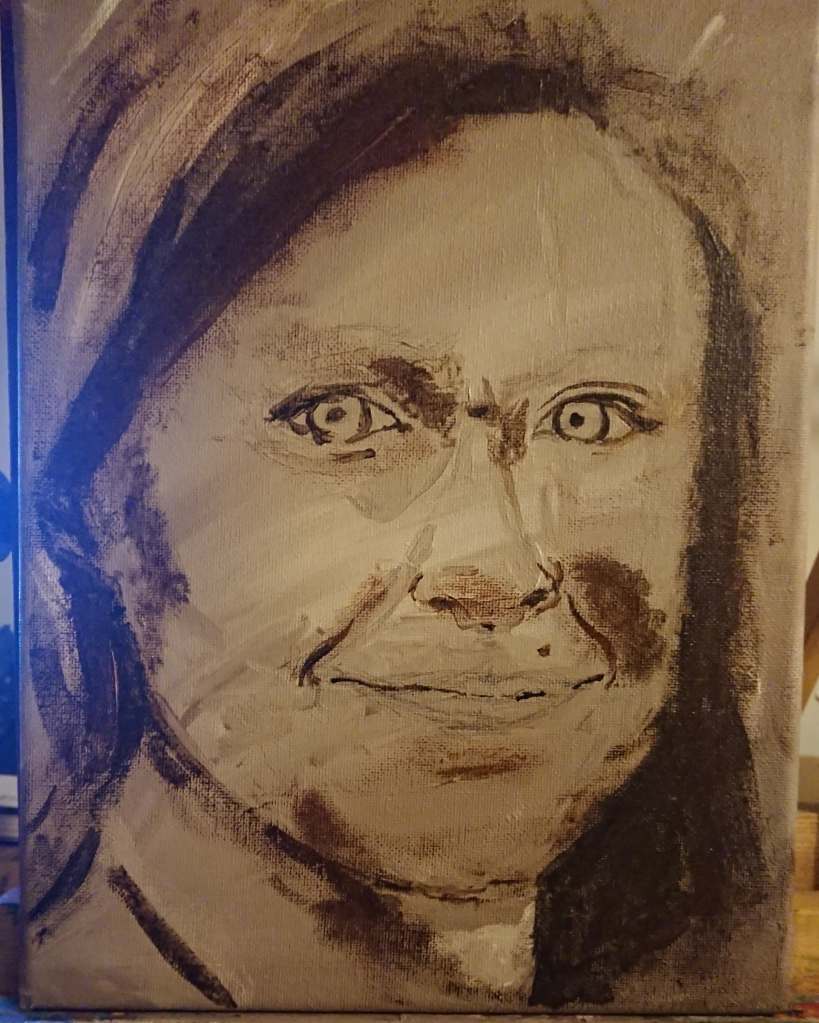
Have dug out some old used canvas boards to practise on – the half-finished paintings of my impatient self. Feels good to revive and make something of them.
I recently watched the Gloria Films with particular focus on the session with Carl Rogers.
I was struck by Rogers’ emphasis on the final stage of the counselling process– the acceptant experience of feelings – particularly when he described the reduction of shame through the process; that it’s not that the client’s ‘bad’ feelings would go away forever, but that by being able to reveal them in an accepting environment, they became untangled from the rest of the narrative, easier to see for what they were, their validity examined and questioned. Through this process the client can experience receiving acceptance from another and begin to see that perhaps their shameful parts really aren’t that bad. With this realisation comes relief and a reduction in shame and rigidity in the client’s self-structure. The client described this herself during the follow-up interview – how she could let go of the need to always feel loving feelings towards her daughter and acknowledge her ambivalent feelings, resulting in being more accepting of her daughter’s ambivalent feelings in turn. I have even more admiration for anyone who engages in the counselling process- through doing the work we are learning to accept ourselves and can give this acceptance to others.
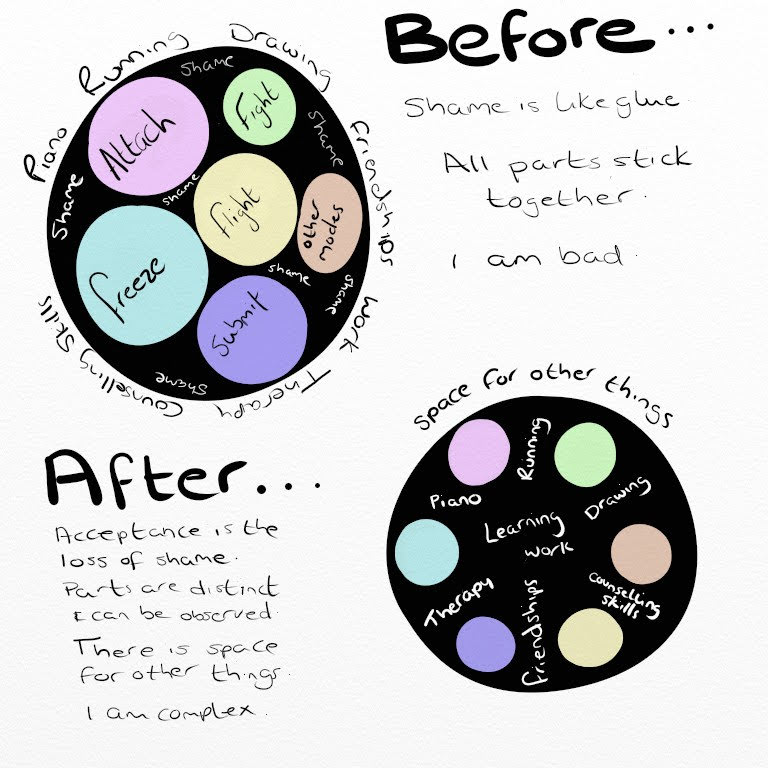
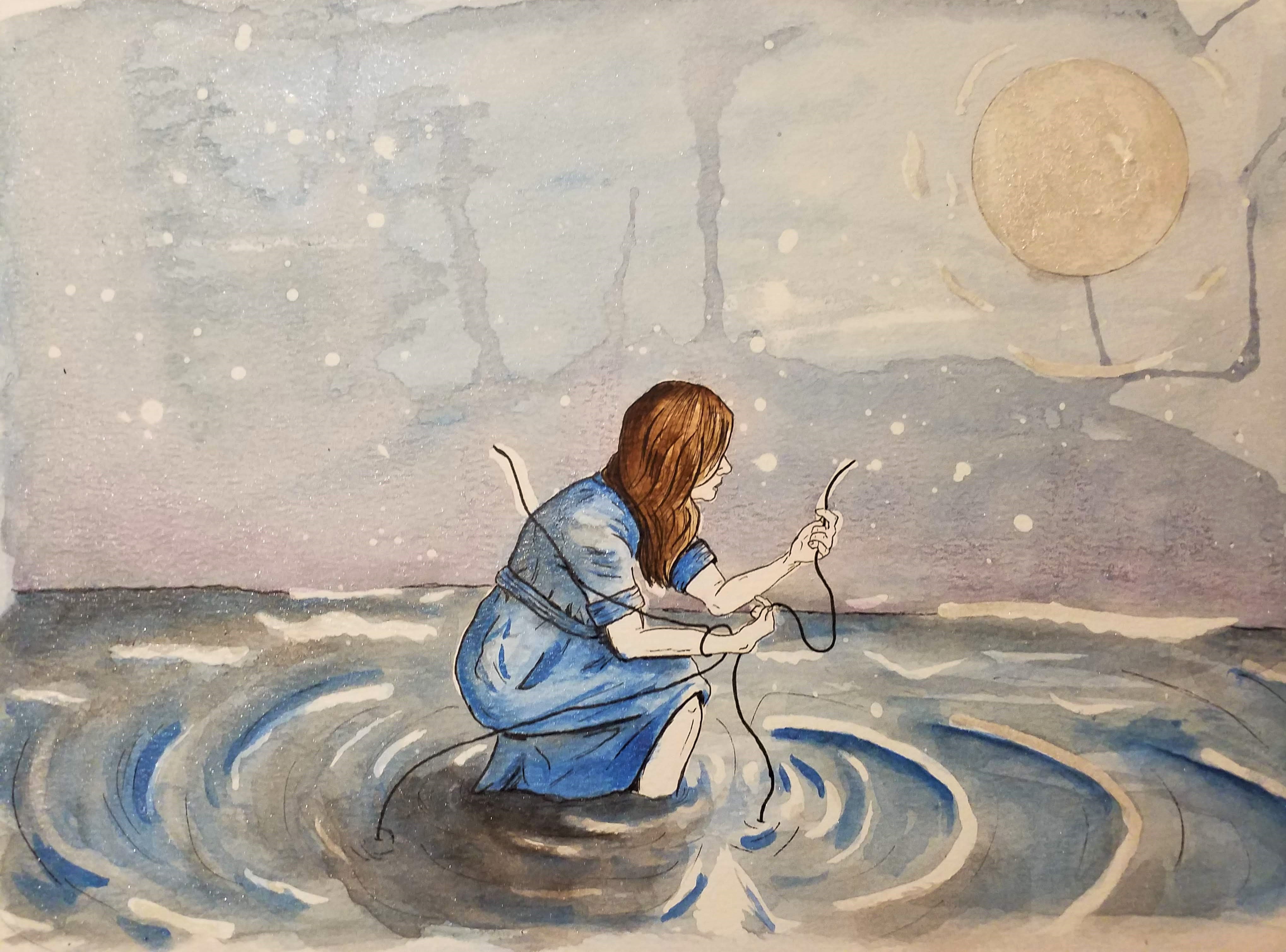
I’ve been interested in the impact of shame for some time and drew the below image as a way of visualising shame as a ‘glue’ that keeps things stuck and prevents fluidity of feelings. Rogers described the ‘immature feeling of which she is ashamed’ – the immature feeling being one aspect of the client – with the aim of therapy being to come to know and accept all aspects, including the ‘shameful’ aspects, to be a whole person, rather than just one thing. We can have childish aspects and experience them, without feeling ashamed. Without shame, we can easily move on to the more ‘grown up’ aspects, rather than becoming stuck through shame.
In the above image I used the theory of trauma parts to illustrate how shame can keep us stuck. Shame is rigid and doesn’t allow us to expand through experiences, leading to over-identifying with our ‘shameful’ parts. Through counselling we can come to appreciate that our parts are adaptations designed to protect us, formed at a time when we were helpless and could do nothing else but adapt to our situation. We can feel admiration, respect and compassion rather than shame, for this pretty amazing ability to adapt, to survive. This reduction in shame loosens our self-structure and we can begin to integrate our current experiences rather than be stuck in the past. The trauma parts don’t go away, but they don’t have to hold sway.
“Person-centred theorists often use the analogy of a plant to describe our concept for growth and change. No one can make a plant grow. But if someone provides the right conditions […] it will become the best plant it can be” (Tolan 2017: p. 9). Person-centred theory understands human development as tending towards wholeness and growth, driven by the actualising tendency – the drive to growth present in every organism that will take full advantage of the situation it is in. There are obstacles to this tendency and the organism adapts in the best way it can to its experience. Over time the situation may change, and the adaptations no longer suit the organism’s environment, leading to conflict with the environment and resulting distress.
The obstacles are conditions of worth and introjected values. We are subject to conditions of worth during our formative years and they send the message that we must be a certain way in order to win approval and be ‘good enough’. These become introjected values within our self-structure, which is the system of beliefs about ourselves and the world that help us make sense of experiences and inform us how to act. These values are from external others and the conditions of worth presented to us. In this way the self-structure forms and adapts to our environment, resulting in a continuing ‘looking outside’ for approval, to make sure we are ‘getting it right’. The introjects remain within us as contribute to how we perceive others, ourselves, and the world around us.
This ‘looking outside’ is attention turned away from the organismic valuing process – a person’s “ability to trust their own thoughts and feelings and to make decisions in accordance with their own perceptions and desires” (Mearns and Thorne 2013: p. 9) – and is referred to as an external locus of evaluation – “reliance on external authorities for guidance […] that may result in […] incongruent behaviour (Mearns and Thorne 2013: p.12). This incongruence between how we act and how we would like to act (informed by our organismic self, our own thoughts, feelings and values) leads to anxiety and other forms of distress.
Our self-structure informs us how to act and what to expect from our environment and others, but it becomes rigid as we grow and is not adaptive beyond formative years, and needs certain core conditions to help it loosen. This struggle for change can lead people to counselling.
It is the role of the person-centred counsellor to provide corrective core conditions that enable a loosening of the client’s self-structure so that they can begin to integrate information from their current experiences, rather than being stuck with the rigid self-structure of the past. This is to “…achieve harmony between experiencing and self-structure so that we can both be ourselves and live in the world (Tolan 2017: p. 9).
Person-centred counselling
“… the task of the person-centred therapist is to provide an environment characterised by a lack of threat to the self-structure” (Tolan 2017: p. 8). Lack of threat can be characterised by the PC core conditions of empathy (entering the experience of the other to experience their feelings and frame of reference), unconditional positive regard (feelings of appreciating and accepting the client no matter what they present), and congruence (being aware and open to whatever feelings may arise about the client). While there is threat, the client will feel distress and cling in to the familiar self-structure for a sense of safety and security. But the actualising tendency is always at work, and all that is needed are the six necessary and sufficient conditions for therapeutic change to occur, as presented by Rogers in 1959 (cited in Tolan 2017: p. 9). These conditions are:
Two persons in psychological contact – aware of and interacting with each other
The client in a state of incongruence – anxious, turbulent, unsure of themselves.
The counsellor is congruent in the relationship – self-aware and aware of the incongruence of the client.
The counsellor experiences unconditional positive regard for the client.
The counsellor experiences empathic understanding of the client and their frame of reference.
The client perceives at least minimally the impact of the preceding two conditions (empathy and unconditional positive regard).
Within a relationship providing these six conditions, the client can begin to express aspects that may be at odds with their self-structure, increasing awareness of their introjected values and questioning their validity. Through the relationship the client broadens their experiences beyond their self-concept, becoming more congruent and therefore at ease in the process, which continues outside the counselling room.
To provide the core conditions the PC counsellor uses a variety of skills, tailored to the stage of the work (which is the stage at which the client is progressing, being a client-led approach). These skills include responding to the client in the moment (immediacy), and reflecting and mirroring the client’s thoughts and feelings, so that the client can hear them back and reflect further. The work is collaborative with regular reviewing of progress and boundaries so that the client is always at the centre of the work.
As I continue to learn about person-centred theory via groupwork, skills practice, and reflective journaling, I observe myself through the theory’s concepts during my everyday interactions and training, to better understand my self-concept (my view of myself and the world), how it formed, its impact, and how it is changing.
References
Mearns, D., Thorne, B. and McLeod, J. (2013). Person-Centred Counselling in Action. 4th edition. London, UK: SAGE Publications Ltd.
Tolan, J. (2017). Skills in person-centred counselling & psychotherapy. 3rd edition. London, UK: SAGE Publications Ltd.
Rogers, C.R. (2004) On Becoming A Person. New Ed edition. London, UK: Constable.
I sometimes find it difficult to write anything for others to read because what I really want to write about is myself, my experiences, and that somehow feels a bit “ick”, self-indulgent, and solipsistic. So I titled this “Ick” to show you, the reader, that I see, I understand, I am with you. But it has to be done.
It is perhaps a mark of “how far I’ve come” (again, ick), that I am able to even admit that, and be okay with it. What I’ve learned is that I’m a few years (read: DECADES) behind in getting to know myself, so everything I’m learning is very exciting and I want everyone to know about it.
In short: I am a teenager.
This delay is a little depressing, but at least I’m not bored. Just ashamed that I’m not a grown-up, or something. 36 is the new 21, right?
Anyway, what I’ve noticed is that, even though I feel so strongly about so many things, I come across as a bit blank to others. This I’ve discovered through my counselling studies (one of my tutors noted: “I have seen this empty persona, Felicity”) and needing to subject myself to constant feedback on how I’m coming across, both in skills practice and in the group generally.
I understand why I keep it all inside and hidden. I understand that it’s protection that no longer serves me. I understand that it’s stifling. I think I’ve come far enough to have done enough work on the origin story.
Now I see that it’s such a great shame because I see others displaying all these feelings and I’m like, “Wow”! It moves me. But that means I’m living vicariously through others who are connected with their feelings and are fully embodied, whereas all I can manage is, “That’s nice”. Ick. Sometimes I feel empty because I can’t even feel the feelings anymore, let alone express them! But I promise, I do feel and I do care. I’m so grateful for all the creators and their books, podcasts and blogs that have been such a comfort and have helped me to connect to myself.
There has been a release to all this pent-up passion over the last few years, in a more constructive way than attaching to someone who possesses those qualities I’ve had to disown in myself, and leeching off them until they disappear (again, very sorry, hope you can take it as a compliment of sorts). Having “done the work” and looked at not only the origins but the various theories on trauma and the impact on the nervous system that help to explain “why I am the way I am” (please stop me now), I can forgive myself for all that and loosen up, which has allowed my “creative energy to flow” (am I even saying these words?!) and I’ve been able to channel those feelings into painting and writing.
And what a relief!
And the more I’ve loosened up, the more I’ve created, and the more I’ve created, the more I’ve come to know myself. This is the safest way to get to know myself, apart from therapy. I can’t fully embody myself – I walk around like a plank most of the time – but I can channel some of those stifled feelings out onto a page or a canvas, and by showing them to others, they come to know me too.
This is the main reason I do it. I want to be known for being me, and I want to be understood, but how to achieve this when I’ve not fully inhabiting myself? I create!
Trite I know, but that is the truth of it. I feel a little sad that it look so long to get to where I am. And because I’m in a good mood (or more accurately, drinking wine) I’ve made it sound so easy. It was not easy, and it’s not over. It never is, is it? Until we die.
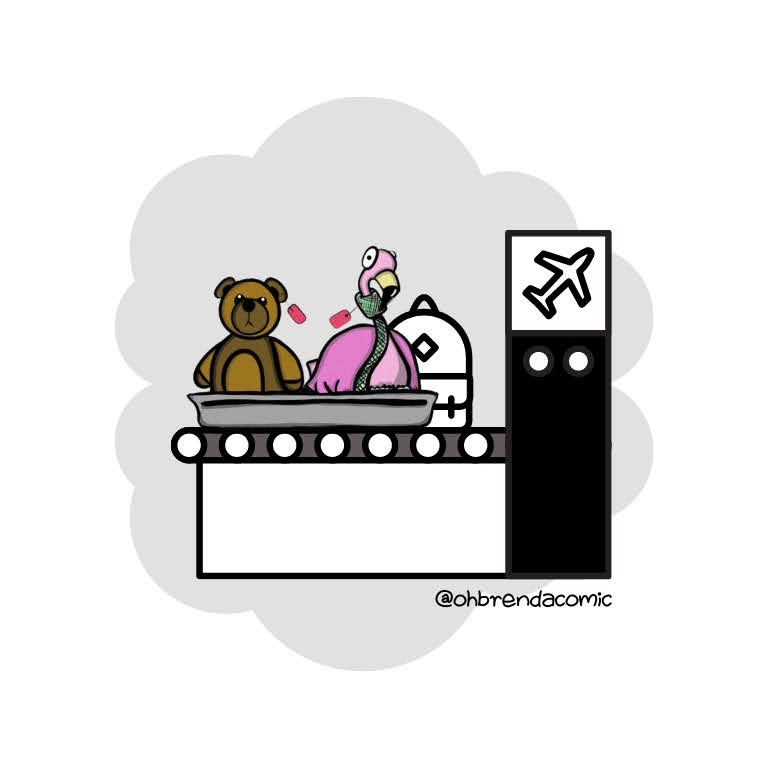
‘Oh, Brenda!’ will follow the misfortunes of a hapless flamingo as she moves to town, facing the challenges of identity, fitting in, inaccurate weather forecasts, a balanced diet, and plain old angst. All with a spirit of curiosity, and a touch of clumsiness.
Join Brenda and a host of human and cuddly characters on social media (links below) from Feb 2022!
I wrote a story for an online exhibition from Paintings in Hospitals – a national charity dedicated to using world-class art to inspire better health for people in the UK. My story combines text, audio, and paintings from the Paintings in Hospitals collection.
You can read my story here: https://artsandculture.google.com/story/PgXhmvVfqhPEOA
The Covid-19 pandemic exposed me to the absurd. Not that I was naive to it, but it couldn’t have coalesced more for me than one morning in a Tesco café surrounded by masked faces and robots outside (I was in Milton Keynes).
Sartre wrote about how everything is always normal in cafes.
During the coronavirus pandemic, between the first and second lockdowns, I found myself in a Tesco café, with the book Nausea, by Jean-Paul Sartre.
Usually a setting where, to me, everything would be reassuringly normal, but it wasn’t. Everyone was wearing masks, everyone was distanced, the cashier was taking all the restrictions and order of things very seriously.
Cafes are all about coffee and breakfast. It just so happened that the pandemic had infiltrated everything.
I’d picked up Nausea that morning and sat down to read it with a latte. Reading that line about cafes increased the feeling of being on another plane somehow. This book was talking to me, threatening my safe place.
During lockdown I imagined that pigeons must have experienced a sense of confusion just as we did. My cafes have been taken over by masks and hand sanitisers and who-are-you-where-have-you-been-and-whom-with monitoring via mobile phones. Nothing new there perhaps, but explicit, and we’re all complicit now, and necessarily so. The virus is invisible, so we make ourselves more visible while we keep away from each other and disappear behind face masks. All while the robots continue to deliver food to MK.
The pigeons must have been struck by the absence of bustle and people and crumbs. People no longer had the distraction of shops, and pigeons no longer had the distraction of crumbs. I imagined pigeons with Nausea.
While in the café and reading the book I had to keep looking up from the reading and taking a deep breath as the Nausea grew. I found myself looking around more at the other customers rather than reading the book, wondering if they were having the same reaction as me., wondering if I stared at them harder I could refocus on where they were and now where the Nausea was.
The cashier was taking all Covid-safe measures so seriously I found myself annoyed. Does she think she can beat this? Yet what else is she to do. This set-up is absurd yet it’s all we’ve got, and we will carry on inexorably towards our coffees and breakfasts.
Nausea is expanding chaos brought together with the flimsy strings of face masks. It’s the increased digital presence and the roaming of robots while we disappear. This is what I experienced while reading Nausea, in the place where, for Sartre, it’s supposed to be kept at bay. The normality of the café continuing underneath it all, a feeling like it shouldn’t be continuing, for goodness’ sake why not stop for a while? It’s Camus’ absurdity – that we continue going to cafes while there is a pandemic going on!
I re-focused on the procedures within the café, I drank my coffee and read. That’s all I could do.
There seems to be an increasing awareness and interest in the practice of Focusing, which Eugene Gendlin developed and published in his 1978 book, Focusing: How To Gain Direct Access To Your Body’s Knowledge.
Focusing is all about finding the ‘felt sense’ of a situation. Rather than deciding what you think about a situation or the emotions it brings, the felt sense is a deeper, more intuitive place, a bodily experiencing. Also important in Focusing is that whatever comes up in the felt sense should be free from judgement. When we’re thinking about something and deciding what to do, there is a lot of analysing and judging. Focusing is about letting things be, observing them. Eugene Gendlin outlined 6 steps for helping people Focusing. It can be done alone or in pairs, with a non-judgemental listener.
Sounds too passive? For many, such as perfectionists and people-pleasers, it’s the ideal way to give themselves a break. And passive it may be, but the time of acceptance can provide clarity on current events and, at the very list, a sense of centeredness and being on your side.
What is the felt sense and how do I identify it?
There are a few ways you can begin to identify your felt sense, to get a better idea of what it is. The following exercises are from Gendlin’s book and others.
The first way to find the felt sense is: imagine you are with a group of friends. Everyone is talking and you’re listening along to the conversation. Suddenly, there is something you feel that you want to contribute. Then, you speak and say what you want to say. The feeling of wanting to say something is the felt sense. Once you begin to articulate it in your mind or verbally, it becomes a thought. You’ve had the feeling of what you wanted to say and transformed it into words to share with others. The felt sense in this instance is telling you there is something you want to say, and the time is now. You put the language onto the felt sense and deliver it so that others understand.
Hopefully from this example it is easy to see how one can ignore the felt sense and how it becomes lost in translation – through fear of judgement from others, for example.
Another way – I believe this is from Gendlin’s book also. Think of two people you know – choose two people towards whom you have very different feelings. Think of one of them, hold the image of them in your head, then notice any feelings in your body that comes up, the general sense of them. It may not immediately be obvious what you are looking for, so it may help to then switch to thinking about the other person, and notice how your general sense of them changes. There should be an initial ‘jolt’ in the felt sense as you switch thoughts, before you begin to think about what the person means to you.
Why is Focusing important?
A previous therapist introduced Focusing into our work when he could see I was feeling something but unable to say what. He asked me where I was feeling it in my body, asked me to describe the felt sense – did it have colour, movement? And finally, with clarity I could say exactly what it was trying to say.
Different to the 6 steps outlined by Gendlin, and there is a cross-over with other somatic techniques. But what I gained was a more compassionate understanding of my emotions because for the first time they were part of me. Rather than thinking I was being a certain way and immediately judging and shaming myself, with Focusing I was more connected with my feelings, beyond the stickiness of shame. This clarity allowed me to label the feelings, what they were trying to say, again removed from the judgement. It was then understandable to me, my feelings, and why I would feel them. It made sense. Connection with ourselves brings compassion, but achieving it means getting out of our heads and into a deeper place, closer to our congruent selves – hence ‘on our side’.
Interestingly, Focusing has a similar effect to taking a step back from a situation when needing to calm down and gain perspective, except the stepping back is from our own thoughts and introjections from others.
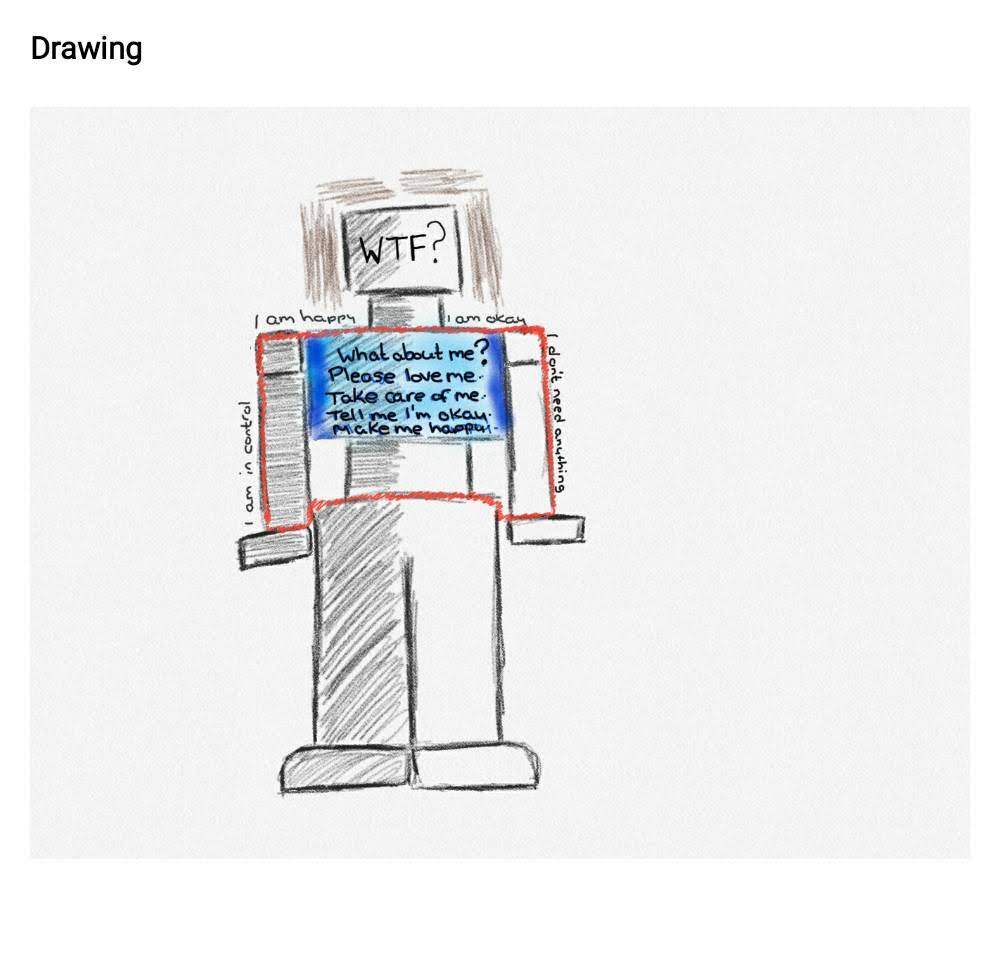
My drawing of the felt sense during therapy. Focusing allowed me to see my feelings in a way I’d never considered them, and this led to self-compassion.
I’m learning to pay more attention to the felt sense, to trust that it won’t lead me astray. I notice it a lot when listening to music. Generally I have my music on shuffle, and sometimes the next song that plays just doesn’t feel quite right. Who knows why that is? If I can, I skip over until I listen to one that feels right. It is different to thinking ‘I want to listen to this’. There is a feeling in my body. The wrong song feels jarring, the correct one feels like a soothing, relaxing across my shoulders and down my arms.
I believe Focusing is important because it allows us to access our bodily knowing that arises, before it is transmuted and muddled and mingled with the expectations of society and others, stranded by ‘shoulds’. After spending time Focusing, I always feel a sense of being on my side. Cheesy, but it feels like a great big hug.
I began practicing watercolour and acrylic art eighteen months ago. With this I have noticed an urgency to produce work quickly, to prove to myself that I can do it and that I am ‘good enough’. This causes an internal pressure that leads to a ‘creative block’, enhancing my belief that I am not good enough. The urgency to prove to myself and to others leads to frustration and fear that inhibits true exploration, creativity and risk-taking, as it leads to stopping work prematurely, not finishing, and not taking risks.
Occasionally I break through the block to produce something I am proud of, but even as my artworks accumulate, the creative block recurs. These ‘…shifts may occur between states of mind in which “thinking” is taking place of a realistic kind, […] and those in which, under the sway of anxiety, thinking becomes separated from its emotional base and irrational or rigid ideas and attitudes begin to supervene (Waddell, 2002, p. 12). Those ‘rigid ideas and attitudes’ include those I developed in childhood – believing I had to be the best at every subject to be good enough.
Excelling became a means to ‘be good’, to find some sense of worth. This relates to Bion’s theories of ‘models of learning’, which can include learning through ‘…imitation, of a mimicking, parroting, adhesive kind; or by […] anxiously seeking to be someone that he or she isn’t …’ (Waddell, 2002, p. 106) as a way of protection and survival. ‘The turbulent and imaginative flowering of her inner-self may be inhibited by an understandable tendency to hang on to what wins approval and makes her feel safe’ (Waddell, 2002, p. 111-112). So much of mainstream school centres around what set you’re in compared to others.
My worth was based on good grades and accumulation of knowledge, rather than self-expression and knowing myself. I became the ‘clever one’. This identity became my defence.
When my artistic frustration is at its worst, I find it is at a time when I am becoming overly-concerned with theory or technique, and seek to accumulate knowing rather than try for myself. According to Bion, ‘Learning of the kind that properly contributed to development […] occurred primary through experience and not through increasing the stock of knowledge’ (Waddell, 2002, p. 113). Making a mistake, for me, became too much of a risk. Through my need to be perfect at everything I do, I can become overly concerned with acquiring the knowledge at the expense of putting it into practice. This leads to frustration and doing very little art-making at all as I judge my work harshly and too quickly, especially when comparing my work to others. ‘This emotion of envy is incompatible with growth and learning’ (Waddell, 2002, p. 115).
I have further observed by need to be ‘good’ and to please others through learning about and practising counselling skills. I have noticed I am uncomfortable with silences and use minimal encouragers generously, filling in too much of the silence and not allowing the space for the client’s train of thought. I do this to show the other that I am listening attentively, that I am obeying and compliant and ‘good’. Silences are difficult because I feel a responsibility to be doing something for the other, to please them. This need to show I am there and willing is compounded by the fear of speaking up, of being too visible. This double-bind has become obvious to me during personal development groups, where I experience anxiety if I speak and anxiety if I remain quiet. I attempt to rectify this by acknowledging this feeling to my peers. My eagerness to please the client in roleplay, by being ‘just right’, takes my attention away from them and onto myself, and is something I have begun to address in personal counselling.
With art, wanting to prove to myself that I am good enough gets in the way of genuine enjoyment of the process and leads to results that do not feel genuine or resonate with some internal part of me. There are occasions when I let this need go and feel a fulfilment that was unfamiliar until a few years ago, which I now know is from my inner-self, the ‘knowing’ that is enhancing my wellbeing as well as my work. Now that I am aware of this I can notice when I am overly concerned with comparing self to others, trying to emulate someone else’s style, and substituting mark-making for reading, and can attempt to rectify by allowing myself to develop ideas in a rough manner before committing to a final piece.
References
WADDELL, M., 2002. Inside lives: Psychoanalysis and the growth of the personality. London, Karnac.