What is Focusing?
There seems to be an increasing awareness and interest in the practice of Focusing, which Eugene Gendlin developed and published in his 1978 book, Focusing: How To Gain Direct Access To Your Body’s Knowledge.
Focusing is all about finding the ‘felt sense’ of a situation. Rather than deciding what you think about a situation or the emotions it brings, the felt sense is a deeper, more intuitive place, a bodily experiencing. Also important in Focusing is that whatever comes up in the felt sense should be free from judgement. When we’re thinking about something and deciding what to do, there is a lot of analysing and judging. Focusing is about letting things be, observing them. Eugene Gendlin outlined 6 steps for helping people Focusing. It can be done alone or in pairs, with a non-judgemental listener.
Sounds too passive? For many, such as perfectionists and people-pleasers, it’s the ideal way to give themselves a break. And passive it may be, but the time of acceptance can provide clarity on current events and, at the very list, a sense of centeredness and being on your side.
What is the felt sense and how do I identify it?
There are a few ways you can begin to identify your felt sense, to get a better idea of what it is. The following exercises are from Gendlin’s book and others.
The first way to find the felt sense is: imagine you are with a group of friends. Everyone is talking and you’re listening along to the conversation. Suddenly, there is something you feel that you want to contribute. Then, you speak and say what you want to say. The feeling of wanting to say something is the felt sense. Once you begin to articulate it in your mind or verbally, it becomes a thought. You’ve had the feeling of what you wanted to say and transformed it into words to share with others. The felt sense in this instance is telling you there is something you want to say, and the time is now. You put the language onto the felt sense and deliver it so that others understand.
Hopefully from this example it is easy to see how one can ignore the felt sense and how it becomes lost in translation – through fear of judgement from others, for example.
Another way – I believe this is from Gendlin’s book also. Think of two people you know – choose two people towards whom you have very different feelings. Think of one of them, hold the image of them in your head, then notice any feelings in your body that comes up, the general sense of them. It may not immediately be obvious what you are looking for, so it may help to then switch to thinking about the other person, and notice how your general sense of them changes. There should be an initial ‘jolt’ in the felt sense as you switch thoughts, before you begin to think about what the person means to you.
Why is Focusing important?
A previous therapist introduced Focusing into our work when he could see I was feeling something but unable to say what. He asked me where I was feeling it in my body, asked me to describe the felt sense – did it have colour, movement? And finally, with clarity I could say exactly what it was trying to say.
Different to the 6 steps outlined by Gendlin, and there is a cross-over with other somatic techniques. But what I gained was a more compassionate understanding of my emotions because for the first time they were part of me. Rather than thinking I was being a certain way and immediately judging and shaming myself, with Focusing I was more connected with my feelings, beyond the stickiness of shame. This clarity allowed me to label the feelings, what they were trying to say, again removed from the judgement. It was then understandable to me, my feelings, and why I would feel them. It made sense. Connection with ourselves brings compassion, but achieving it means getting out of our heads and into a deeper place, closer to our congruent selves – hence ‘on our side’.
Interestingly, Focusing has a similar effect to taking a step back from a situation when needing to calm down and gain perspective, except the stepping back is from our own thoughts and introjections from others.
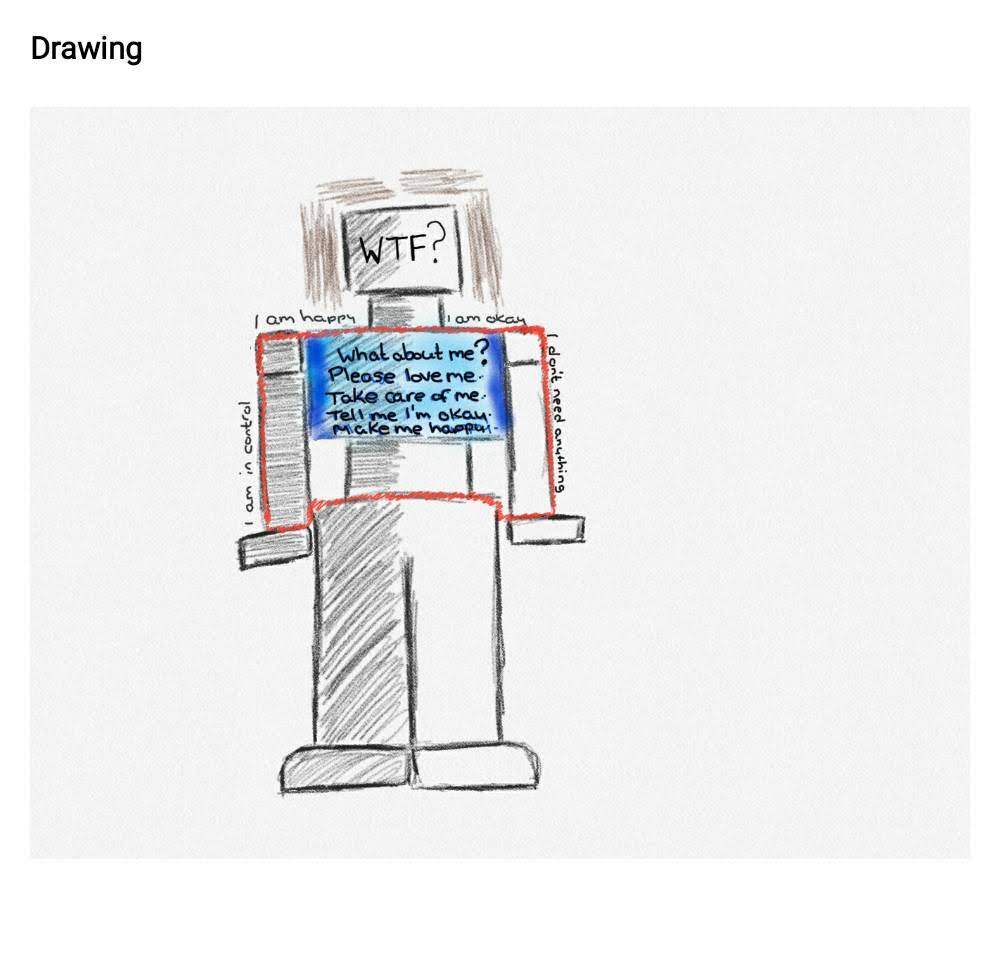
I’m learning to pay more attention to the felt sense, to trust that it won’t lead me astray. I notice it a lot when listening to music. Generally I have my music on shuffle, and sometimes the next song that plays just doesn’t feel quite right. Who knows why that is? If I can, I skip over until I listen to one that feels right. It is different to thinking ‘I want to listen to this’. There is a feeling in my body. The wrong song feels jarring, the correct one feels like a soothing, relaxing across my shoulders and down my arms.
I believe Focusing is important because it allows us to access our bodily knowing that arises, before it is transmuted and muddled and mingled with the expectations of society and others, stranded by ‘shoulds’. After spending time Focusing, I always feel a sense of being on my side. Cheesy, but it feels like a great big hug.

