I recently watched the Gloria Films with particular focus on the session with Carl Rogers.
I was struck by Rogers’ emphasis on the final stage of the counselling process– the acceptant experience of feelings – particularly when he described the reduction of shame through the process; that it’s not that the client’s ‘bad’ feelings would go away forever, but that by being able to reveal them in an accepting environment, they became untangled from the rest of the narrative, easier to see for what they were, their validity examined and questioned. Through this process the client can experience receiving acceptance from another and begin to see that perhaps their shameful parts really aren’t that bad. With this realisation comes relief and a reduction in shame and rigidity in the client’s self-structure. The client described this herself during the follow-up interview – how she could let go of the need to always feel loving feelings towards her daughter and acknowledge her ambivalent feelings, resulting in being more accepting of her daughter’s ambivalent feelings in turn. I have even more admiration for anyone who engages in the counselling process- through doing the work we are learning to accept ourselves and can give this acceptance to others.
I’ve been interested in the impact of shame for some time and drew the below image as a way of visualising shame as a ‘glue’ that keeps things stuck and prevents fluidity of feelings. Rogers described the ‘immature feeling of which she is ashamed’ – the immature feeling being one aspect of the client – with the aim of therapy being to come to know and accept all aspects, including the ‘shameful’ aspects, to be a whole person, rather than just one thing. We can have childish aspects and experience them, without feeling ashamed. Without shame, we can easily move on to the more ‘grown up’ aspects, rather than becoming stuck through shame.
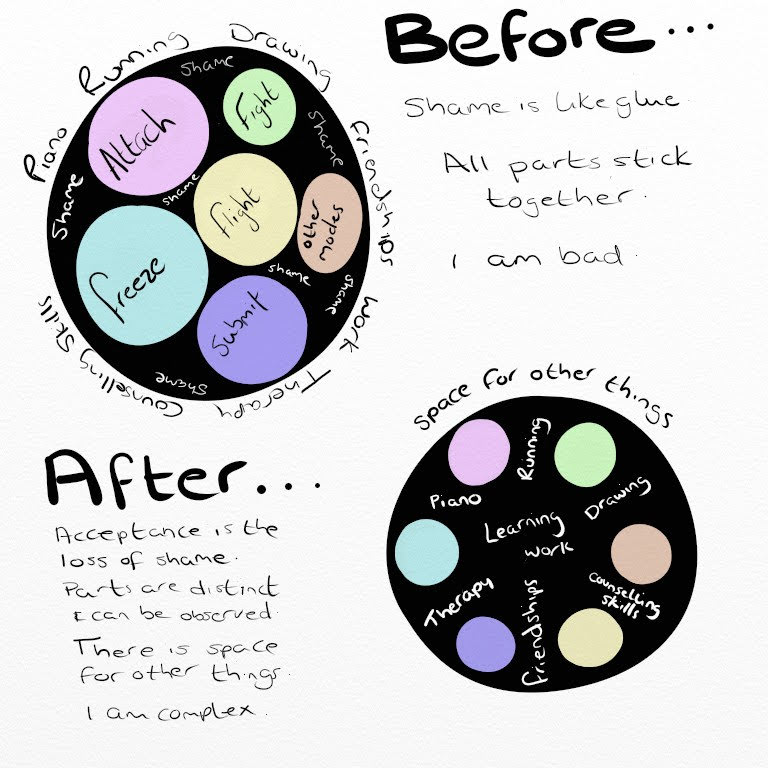
In the above image I used the theory of trauma parts to illustrate how shame can keep us stuck. Shame is rigid and doesn’t allow us to expand through experiences, leading to over-identifying with our ‘shameful’ parts. Through counselling we can come to appreciate that our parts are adaptations designed to protect us, formed at a time when we were helpless and could do nothing else but adapt to our situation. We can feel admiration, respect and compassion rather than shame, for this pretty amazing ability to adapt, to survive. This reduction in shame loosens our self-structure and we can begin to integrate our current experiences rather than be stuck in the past. The trauma parts don’t go away, but they don’t have to hold sway.

