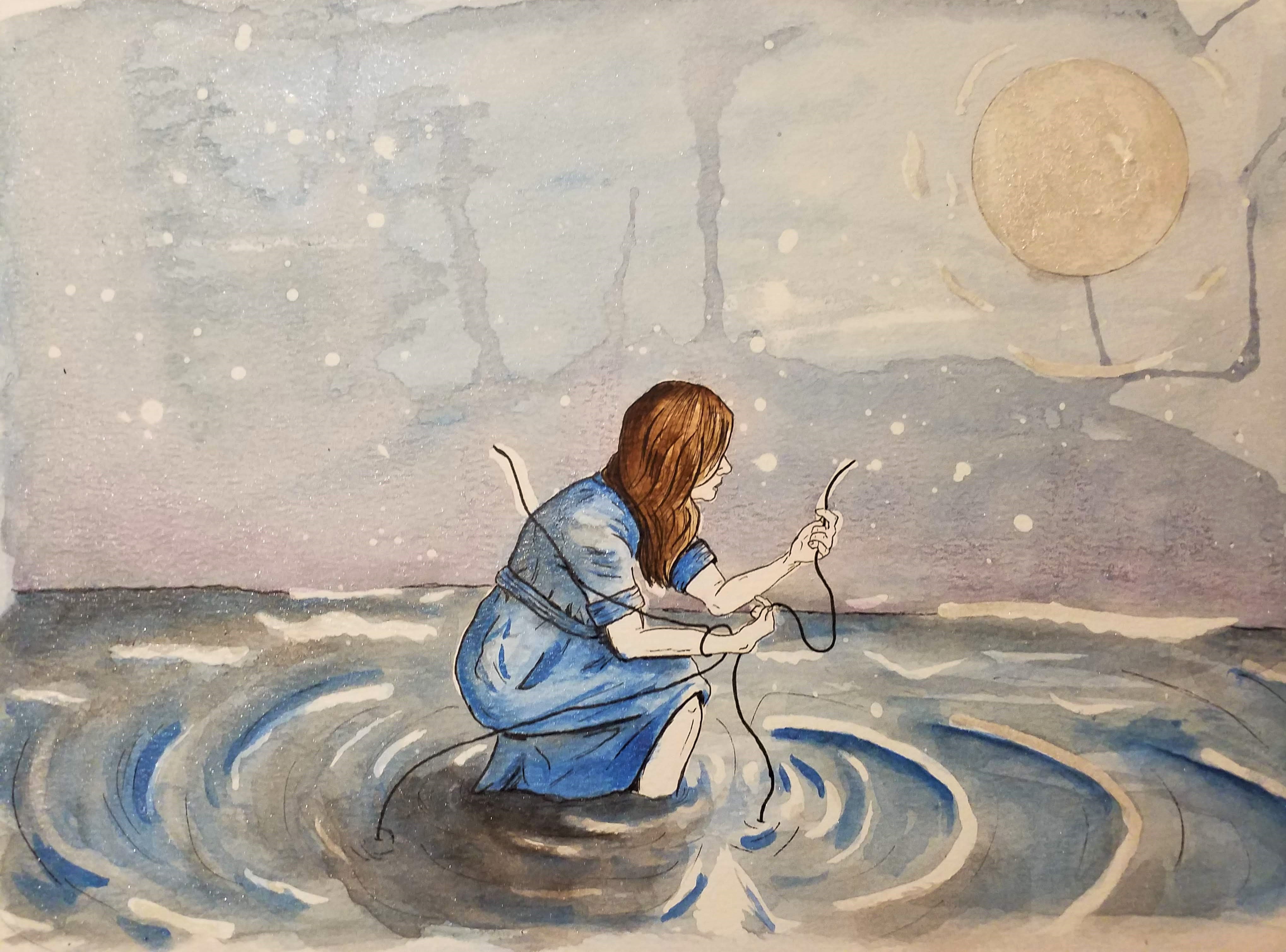
I began practicing watercolour and acrylic art eighteen months ago. With this I have noticed an urgency to produce work quickly, to prove to myself that I can do it and that I am ‘good enough’. This causes an internal pressure that leads to a ‘creative block’, enhancing my belief that I am not good enough. The urgency to prove to myself and to others leads to frustration and fear that inhibits true exploration, creativity and risk-taking, as it leads to stopping work prematurely, not finishing, and not taking risks.
Occasionally I break through the block to produce something I am proud of, but even as my artworks accumulate, the creative block recurs. These ‘…shifts may occur between states of mind in which “thinking” is taking place of a realistic kind, […] and those in which, under the sway of anxiety, thinking becomes separated from its emotional base and irrational or rigid ideas and attitudes begin to supervene (Waddell, 2002, p. 12). Those ‘rigid ideas and attitudes’ include those I developed in childhood – believing I had to be the best at every subject to be good enough.
Excelling became a means to ‘be good’, to find some sense of worth. This relates to Bion’s theories of ‘models of learning’, which can include learning through ‘…imitation, of a mimicking, parroting, adhesive kind; or by […] anxiously seeking to be someone that he or she isn’t …’ (Waddell, 2002, p. 106) as a way of protection and survival. ‘The turbulent and imaginative flowering of her inner-self may be inhibited by an understandable tendency to hang on to what wins approval and makes her feel safe’ (Waddell, 2002, p. 111-112). So much of mainstream school centres around what set you’re in compared to others.
My worth was based on good grades and accumulation of knowledge, rather than self-expression and knowing myself. I became the ‘clever one’. This identity became my defence.
When my artistic frustration is at its worst, I find it is at a time when I am becoming overly-concerned with theory or technique, and seek to accumulate knowing rather than try for myself. According to Bion, ‘Learning of the kind that properly contributed to development […] occurred primary through experience and not through increasing the stock of knowledge’ (Waddell, 2002, p. 113). Making a mistake, for me, became too much of a risk. Through my need to be perfect at everything I do, I can become overly concerned with acquiring the knowledge at the expense of putting it into practice. This leads to frustration and doing very little art-making at all as I judge my work harshly and too quickly, especially when comparing my work to others. ‘This emotion of envy is incompatible with growth and learning’ (Waddell, 2002, p. 115).
I have further observed by need to be ‘good’ and to please others through learning about and practising counselling skills. I have noticed I am uncomfortable with silences and use minimal encouragers generously, filling in too much of the silence and not allowing the space for the client’s train of thought. I do this to show the other that I am listening attentively, that I am obeying and compliant and ‘good’. Silences are difficult because I feel a responsibility to be doing something for the other, to please them. This need to show I am there and willing is compounded by the fear of speaking up, of being too visible. This double-bind has become obvious to me during personal development groups, where I experience anxiety if I speak and anxiety if I remain quiet. I attempt to rectify this by acknowledging this feeling to my peers. My eagerness to please the client in roleplay, by being ‘just right’, takes my attention away from them and onto myself, and is something I have begun to address in personal counselling.
With art, wanting to prove to myself that I am good enough gets in the way of genuine enjoyment of the process and leads to results that do not feel genuine or resonate with some internal part of me. There are occasions when I let this need go and feel a fulfilment that was unfamiliar until a few years ago, which I now know is from my inner-self, the ‘knowing’ that is enhancing my wellbeing as well as my work. Now that I am aware of this I can notice when I am overly concerned with comparing self to others, trying to emulate someone else’s style, and substituting mark-making for reading, and can attempt to rectify by allowing myself to develop ideas in a rough manner before committing to a final piece.
References
WADDELL, M., 2002. Inside lives: Psychoanalysis and the growth of the personality. London, Karnac.

