I’ve finished reading The Flowers of Evil by Charles Baudelaire. I thought I’d write a summary of the themes and some personal reflections on this collection; what I think the poet is trying to convey through his use of imagery, the recurring themes, and my own responses to him.
A bit about the book and the poet:
Charles Baudelaire (1821-1867) was a poet and essayist in Paris.
Thanks for reading Fee’s Substack! Subscribe for free to receive new posts and support my work.
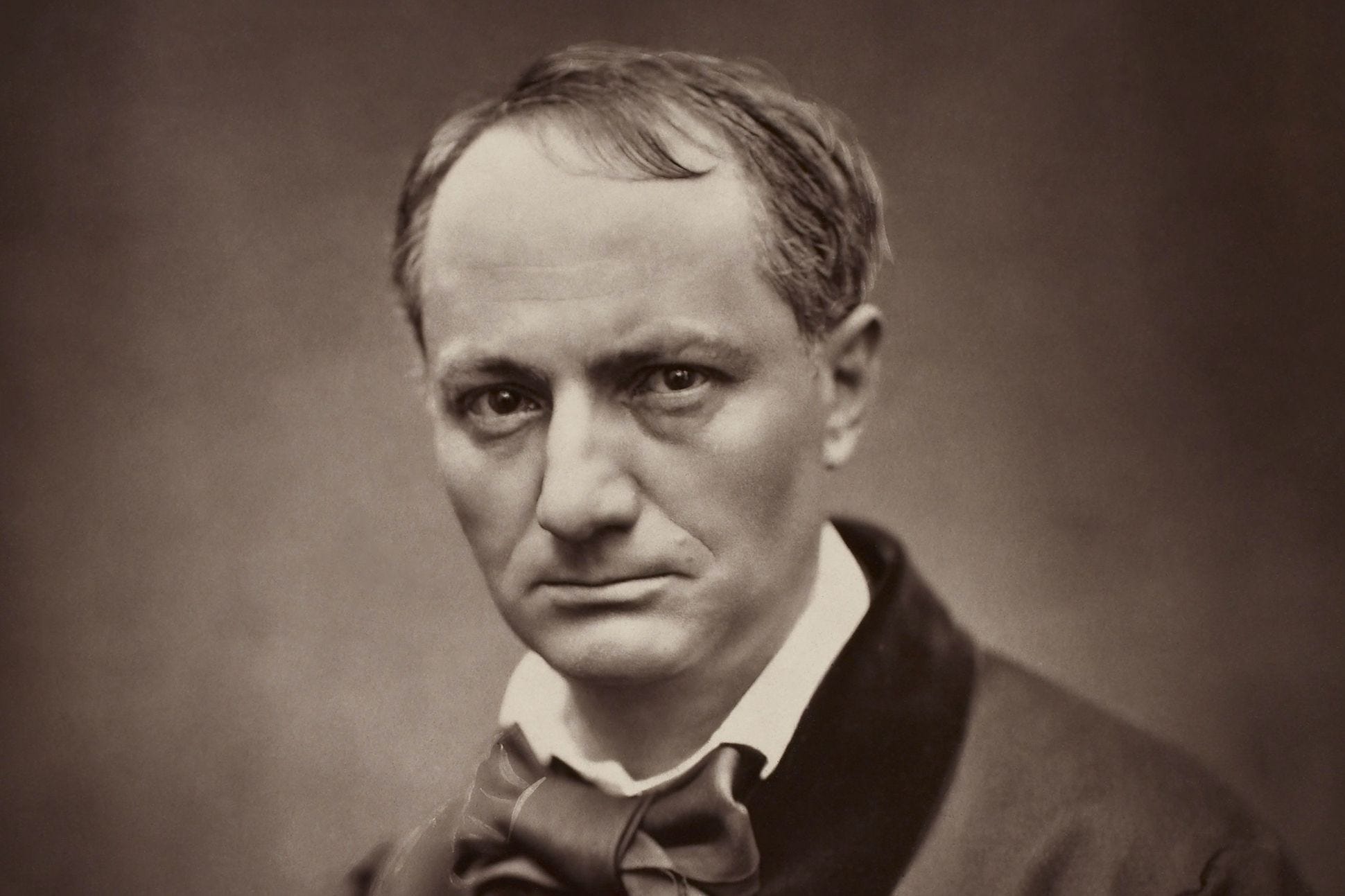
Woodburytype of a portrait of Charles Baudelaire by Étienne Carjat. Charles Baudelaire | The Poetry Foundation
The Flowers of Evil was published in 1857. The poems within were written in the 1840s and 1850s. This collection was controversial at the time, with a trial and fine for the poet, and the banning of 6 poems.
The Flowers of Evil
This collection is filled with ambivalence – moral, sexual, emotional, spiritual. From the title we see this – something beautiful as a flower can come from something considered evil or sinful. I found it infuriating and fascinating, and never was I more aware of my own responses as a reader as when reading this collection.
Spleen and ideal
The first section is titled Spleen and ideal. Spleen refers to a melange of feelings – intense boredom, disgust, helplessness, melancholy, and futility. Here the scene is set for a poet searching for an ideal as a counter to spleen, and experiencing intense ambivalence towards the means of achieving his escape (creating flowers, but sinful ones).
What do we know of Baudelaire’s spleenful feelings?
Boredom
Nothing is slower than the limping days
when under the heavy weather of the years
Boredom, the fruit of glum indifference,
gains the dimension of eternity …
- Spleen (II)
Helplessness
I’m like the king of a rainy country, rich
but helpless, decrepit though still a young man
- Spleen (III)
Disgust
When skies are low and heavy as a lid
over the mind tormented by disgust,
and hidden in the gloom the sun pours down
on us a daylight dingier than the dark;
- Spleen (IV)
Death
The sense of spleen is also emphasised through death imagery such as carrion, corpses, graves, soil, worms.
And heaven watched the splendid corpse
like a flower open wide –
you nearly fainted dead away
at the perfume it gave off.
[…]
-Yet you will come to this offence,
this horrible decay
you , the light of my life, the sun
and moon and stars of my love!
- Carrion
Time
Flesh is willing, but the Soul requires
Sisyphean patience for its song.
Time, Hippocrates remarked, is short,
and Art is long.
- Artist unknown
The poet is afraid of the loss of vitality over time, before his work can be done; of being forgotten. Further shown in the poem [ ] he describes battle-weariness.
Once you were hot for battle, weary mind!
Now Hope, whose spur awakened all your zeal,
no longer even mounts. […]
- Craving for Oblivion
Time as the enemy, and grief over time wasted:
My youth was nothing but a lowering storm
occasionally lanced by sudden suns;
torrential rains have done their work so well
that no fruit ripens in my garden now.
Already the autumn of ideas has come
and I must dig and rake and dig again
If I am to reclaim the flooded soil
collapsing into holes the size of graves.
I dream of new flowers, but who can tell
If this eroded swamp of mine affords
the mystic nourishment on which they thrive …
Time consumes existence pain by pain.
[…]
- The Enemy
Futility
Futility is a strong theme through the collection. The comparison of the poet to a rock when in his ‘moods’, where not even dropping into the sea (usually a source of that escape into emptiness) cannot help him:
“You’re like some rock the sea is swallowing –
what is it that brings on these moods of yours?”
Nothing mysterious: the ordinary pain
of being alive. You wouldn’t understand,
[…]
- Semper Eadem (always the same)
The futility of difficult feelings is demonstrated through the use of the Greek myth of the Danaides, the fifty daughters of King Danaus, forty nine of whom murdered their husbands and were condemned to labor in Hades, trying to fill a leaking vessel with water. The poet uses the image of the cask as synonymous with trying to his hate and the futility of this, the futility of such feelings:
Hate is the Cask of the Danaides
even Vengeance, frenzied and red-armed,
cannot replenish those depths fast enough
with bucketfulls of blood and dead men’s tears –
Hell thirsts on, mysterious holes appear
and through them seep a thousand years of toil […]
happy is the man who drinks to meet his fate,
but Hate is fettered to a fiercer doom
and cannot even drink himself to death.
- The Cask of Hate
He’s describing a man in conflict with himself, seeming to be resisting what he believes to be his nature or his fate (these moods he experiences and the battle-weariness), and seeing this as futile, wasted time and energy running out through holes.
Baudelaire capitalises feelings throughout this collection as if they are proper nouns, giving them more weight and substance, and therefore showing us the powerful force they have on him.
So how does the poet deal with these spleenful feelings?
Our poet seeks oblivion and forgetting as an escape from spleen, and he seeks this in a number of ways. Early in the collection things start off hopeful with the poem ‘Elevation’:
Ascend beyond the sickly atmosphere
to a higher plan, and purify yourself
by drinking as if it were ambrosia
the fire that fills and fuels Emptiness.
Free from the futile strivings and the cares
which dim existence to a realm of mist,
happy is he who wings an upward way
on mighty pinions to the fields of light;
- Elevation
This striving for oblivion has a more hopeful and exalted tone than many of the others poems, an embracing as opposed to a desperate cleaving from the self. He’s an artist endeavouring to find his place above the rest of society where his soul can ‘wander at ease’ with ‘an unutterable male delight’. He wants oblivion from the confines of his sex, societal status, as well as his inner ‘cares’; out of himself, and out of the streets of Paris and their sick air.
The Classics were another way that Baudelaire attempted to escape from reality, and references to Greek mythology occur throughout the collection. In the poem The Sick Muse, he’s imploring his muse to be ‘as steadfast as the copious Classical vein…’,
Indeed, the classics appear to be the only thing in the collection that is steadfast for Baudelaire. Even his cat, usually insouciant, is upset by the February rains of Spleen (I) (one of my favourite poems from the collection):
The tiles afford no comfort to my cat
that cannot keep its mangy body still;
the soul of some old poet haunts the drains
and howls as if a ghost could hate the cold.
- Spleen (I)
A bit about cats: the poet seems to love, even revere them. I think identifying something of himself in them; perhaps their ability to also slip in anywhere in Paris society where he himself feels alienated or envious (as in Gamblers); They are nonchalant, free of worry or concern, unlike our writer. He writes that the cat cannot be comforted in Spleen (I), giving cause for concern for our poet in February’s drizzle if even the cat is perturbed.
One of the most striking poems in the collection in which we can really examine Baudelaire’s relationship to spleen, is the poem Mists and Rains, which occurs in the ‘Parisian Scenes’ section of the collection:
Waning autumn, winter, mud-bound spring-
I thank these somnolent seasons that I love
for offering to both my heart and mind
so vaporous a shroud, so vague a tomb.
- Mists and rain
There is so much to unpack in this one stanza. First, the irony being that these seasons that he loves are clearly not the ones he loves, for his encounter with them, particularly in the Spleen poems, indicates the weather as a focal point for these feelings. Also, what is offered is associated with death (shroud and tomb) yet these are vaporous and vague. The poet is describing something akin to the peace of death, which is also referred to in the collection (death as the ultimate oblivion) but being granted in a vague way to as give some peace without the ultimate oblivion. How restful it is for him, how wanted and rejuvenating in the end, is so wonderfully ambiguous here. Perhaps he is seeing this vague death-like state as being like a sleep, the sleep he wishes for in the poem Lethe (“I want to sleep – not live, but sleep!”) He wants this state as an escape from spleen.
Why is he experiencing such feelings? Something about the artist’s openness to experience, encountering the full spectrum of feelings and of society. We see through the collection that he is seeing what others turn away from.
In Obsession, nature is no longer a pleasant escape but seems to invigorate his unwanted emotions:
Forest, I fear you! in my ruined heart
your roaring wakens the same agony
as in cathedrals when the organ moans
and from the depths I hear that I am damned.
- Obsession
We see other means of escape, including opium and gambling. He refers to the people here as ‘stubborn’. He is seeking something stubborn and steadfast in himself, some reprieve, and envying those that seem to have it in abundance and seemingly without trial:
Horrible, that I should envy these
who rush so recklessly into the pit,
each in his frenzy ravenous to prefer
pain to death, and hell to nothingness.
- Gamblers
A clue in this title is that to seek out these feelings that will either awaken or sicken the muse, is a gamble. The writer’s feelings of alienation are acute in this poem; alienated in place as well as within the progress of his own creative journey.
So here we have the imagery that sets the tone for the poet’s internal state. Spleen is a melange of boredom, futility, disgust, melancholy and helplessness, using imagery of death, dreary weather, dinginess, and gloominess, to convey these feelings to the reader. We see a poet attempting to rise above this as a good artist should. He is clear to the reader about the power and feelings of futility of spleen – even the cat is perturbed!. Despite the painful spleen, there’s ambiguity around the poet’s relationship with it, a suggestion perhaps of the welcoming of the very conditions that bring these feelings forth. This becomes more evident as we look at Baudelaire’s relationship to women.
Women
Women are a subject towards whom Baudelaire is ambivalent, a source of both desire and disgust for him. He had a long-term partner with whom he had a long-term, on-off and tumultuous relationship, so I interpret many of the more intimate poems as being about that relationship.
His poems convey at times an intense erotic desire for a woman as distraction against spleen:
For nothing silences my sobs
like the abyss that is your bed:
oblivion occupies your mouth
and Lethe runs between your lips …
- Lethe
Lethe (in Greek mythology, one of the rivers running through Hades that can grant the drinker forgetfulness of their earthly lives) is mentioned numerous times. Here it is linked to an erotic encounter with a woman as a way to forget.
He writes of nature, especially water, as something rejuvenating, a dive into that same emptiness of sky in Elevation, and later links this to the physical attributes of his lover, comparing his lover’s hair to “a harbor where my soul can slake its thirst”.
For example, here is the power of nature for Baudelaire:
Into this image of himself he dives
his arms and eyes wide open and his heart
sometimes diverted from its own dead march
His heart being diverted from its own dead march! The poet transcends the corporeal through his encounter with the sea.
And now to his lover’s hair:
For color, sound and smell – where ships that glide
among the seas of golden silk throw side
their yardarms to embrace a glorious sky
palpitating in eternal heat’
- The Head of Hair
Exalted again, he is throwing his arms out to the sky, into that brilliant emptiness from the poem ‘Elevation’, from the sea of his lover’s hair. Transcending through his erotic encounters.
And how delicious is this other stanza from ‘The Head of Hair’:
Take me, tousled current, to where men
as mighty as the trees they live among
submit like them to the sun’s long tyranny;
The sun gives life to trees yet here it is tyrannous. Women to Baudelaire are as the sun described here for trees.
Here we are getting an idea of the conflicting feelings towards the lover, and this carries on unabashedly throughout the collection.
No only are erotic encounters escape, they are also considered sinful:
Come from Satan, come from God – who cares,
Angel or Siren, rhythm, fragrance, light,
provided you transform- O my one queen!
this hideous universe, this heavy hour?
- Hymn to beauty
and a source of destruction:
In love I’ve sought an hour’s oblivion-
but love to me is a pallet stuffed with pins
that drains away my blood for whores to drink!
- The Fountain of Blood
and distraction from his creative ambitions and the artists’ path, where even the most diligent hands are powerless:
Sometimes (for he* knows my love of Art
he visits in a seductive woman’s form
and with the specious alibis of despair
inures my lips to squalid appetites.
Thereby he leads me out of God’s regard,
spent and gasping – out to where the vast
barrens of Boredom stretch infinitely.
Destruction
*referred to earlier in the poem as a demon.
The question becomes: how much is our poet restored by these encounters? We already have the tyrannical life-giving sun. Is there some balance to be achieved?
What is the impact of these encounters on the creative muse?
Good morning, Muse – what’s wrong? Something you saw
last night is left in your hollow eyes;
your colours bad, your cheek are cold
with horror, with madness! – and you don’t say a word.
Are you silenced by the love and fear dispensed
by greenish vampires, rosy ghouls?
[…]
Not like this … I want you safe and sound,
[…]
and steadfast as the copious Classical vein ..
- The Sick Muse
The evening’s encounter brought both love and fear, and both upset the muse. The very feelings that could be a source for writing but the words don’t come! For a poet that sees beyond life’s grime, this is infuriating. How desperately he wants to transform this pain into poetry! He sees himself as diligent (indeed, recognises that he among men can see others as their whole and not their outer circumstances), further emphasising the power of his inner feelings.
There’s a distinction between the “fruitful lethargy” described in ‘The Head of Hair’ and the spleenful, battle-weary lethargy, yes as a reader I suspect that the poet is appreciating both (though the appreciation likely comes much after the fact).
Baudelaire sometimes feels powerless against the erotic pull:
My destiny is my desire
which I obey as if foredoomed:
innocent martyr, eager prey
whose fervor hones his agony
[…]
I’ll suck enough to drown my spite
at those entrancing pointed breasts
which never have confined a heart
-Lethe
“whose fervor hones his agony” – another indication perhaps that the poet is seeking out such feelings so as to exploit them as is his calling, like the diligent monk who in this case is bad:
He is aware of his calling and responsibility as a poet to transform his feelings into art:
‘[…] when shall I make
the living pageant of my misery
into the work of my hands and the love of my eyes?
- The Bad Monk
Encounters with the erotic become as a drug – more required but leaving the user requiring more.
From the poem Sed non satiata (“yet not satisfied”):
[…] And yet
to wine, to opium even, I prefer
the elixir of your lips on which love flaunts
itself; and in the wasteland of desire
your eyes afford the wells to slake my thirst.
The irony of course is that his love of women, or one woman in particular, is bringing these poems forth. I am not sure he would have considered women as muses, however. He speaks of the muse as something internal (The Sick Muse) that he must protect at all costs; something that can be distracted and destroyed by life.
So here we have the poet’s highly ambivalent feelings about his erotic encounters with women. To him, they are pleasant escapes and a way to forget spleenful feelings. They can be fruitful, but can also be draining. At times enamoured by his love and revelling in the encounters, at other times despairing to find his words drained and his hands still. Like the sun that can be tyrannous to the trees, we see a man wanting to reach an equilibrium with himself and his surroundings. This is difficult for a poet who sees deeply across the spectrum of Parisian society, envying the steadfastness of others and never quite achieving it (and one suspects, doesn’t really want to).
Paris scenes
When it comes to the Paris Scenes section, the view of women is rather more tender. As a true poet he is seeing the whole of them, their past, present and future selves, their struggles and treatment by society. He views himself among the few artists capable of seeing them fully:
But I who at distance follow you
and anxiously attend your failing steps
as if I had become your father – mine
are secret pleasures you cannot suspect!
I see first love in bloom upon your flesh,
dark or luminous I see your vanished days –
- The Little Old Women
It’s as if coming out of thoughts of his lover(s) and into the wider world of the streets of Paris, his view is softening in the context of the city. Against change, poverty, revolution, a widening view and increased sensitivity to the trials of others.
Ambivalence also enables him to see and acknowledge the spectrum of society. In The Red-Haired Beggar Girl he refers to himself as being “reduced” as she is. He is identifying something of himself in her, though their existences are worlds apart, just as he sees something of himself in the old women:
and all beguile me, but especially
those who, honeying their pain, implore
addiction that had once lent them its wings:
“Mighty Hippogriff, let me fly again!”
- The Little Old Women
With the old women, he is perhaps considering his own struggle with the march of time.
He’s seeing beneath their shells and circumstances. With the red-haired beggar girl we can see that were it not for her circumstances, just for the want of a brocaded dress, he understands that she would have men under her control. With the old women, he sees their lost eroticism and figure, and were it not for the ravages of time they would still be noticed by the world.
Gaping tatters in each garment prove
your calling is not only beggary
but beauty as well,
[…]
Queens in velvet buskins take the stage
less regally than you wade through the mud
on your wooden clogs.
- To a Red-Haired Beggar Girl
Summary of reflections and how the collection made me feel
I think I have responded to this in such a way as to write a reflection because there’s a stark honesty and realism from Baudelaire. Haughty, yes, seeing himself as one of the few that can see beyond the surface. He recognised an equal in his contemporary Victor Hugo, and the poems to him from the Paris scenes sections are among the most gathered and least emotionally fraught, in part perhaps to impress such a writer, but I think also because Baudelaire is looking outside himself. There is a difference between the poems of the inner turmoil and those about Paris in their directness of the people described. He does for people as van Gogh did with his portraits; he brings them to us and makes them painfully real. I believe that there was a red-haired beggar woman and a specific group of old ladies, and these poems reflect them and not an amalgamation.
When writing about himself, he is painfully real, and it’s no wonder artists have been so drawn to his work given the inevitable conflicts and pains that come with an openness to experience. With this openness comes a sense of isolation and alienation, seeing a place for himself everywhere and nowhere, envious of people seemingly knowing and happily accepting their place. Such feelings, even the cat is disturbed, and cats can go anywhere!
Never have I felt closer to the Parisian 19th century streets than through these poems. For all the grime and danger and dank, social upheaval and revolutions, I would love to visit them. Baudelaire brings me so close to his reality with his words.
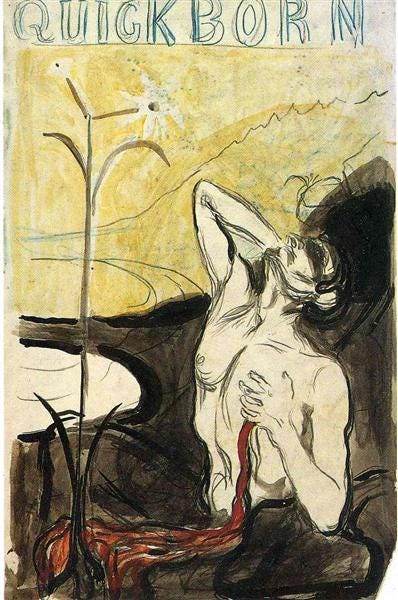
The Flower of Pain, 1897 – Edvard Munch – WikiArt.org
An artist of great intensity of feeling, observing the full spectrum of society, battling with the weight of existence and freedom, with great ambivalence towards himself and others. It has taken multiple readings of many of the poems to really pick up on the poet’s wanting spleenful feelings; an active seeking out of the very conditions that bring him feelings of weariness, futility, melancholy, and disgust; the clever ways he delivers this and then leaves the reader in a spin. The description of women ‘honeying’ their pain – making it sweeter or as bees creating it, to bring the causes of their addictions that would help them escape. Next I would like to consider how this is conveyed through his poems in more detail, considering the poetical devices used.
As a reader I was discomfited by the unreliability of nature to soothe his soul; at one point exaltation and escape from the corporeal, at others mirroring his internal pain. One one time he can embrace the ‘somnolent seasons’ as a time for his soul to take flight, at others even his beloved cat finds no rest. As a reader perhaps my response is from wanting the comfort of some reliable sources of solace, some steadfastness of my own (though I often fear that, with too much inner calm, my words would dry up, and I definitely bring these feelings to my reading of this collection).
References
All excepts from the Kobo ebook:
Baudelaire, Charles. The Flowers of Evil. R. Howard (trans). Verba Mundi, 2025.

